 | |
Amanita ocreata vs. Amanita velosaMike McCurdy Tis the season
Amanita ocreata is deadly. Amanita velosa is an excellent edible. Both are Amanitas, but distinct. However, their seasons overlap, and they associate with the same tree. There is no reason to confuse these mushrooms.Amanita ocreata vs. Amanita velosa By Mike McCurdy 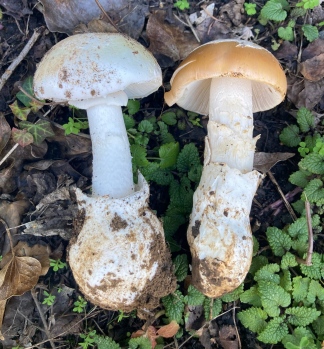 A. ocreata vs. A.velosa A well-known person in the Bay Area mushroom community, who has a penchant for hyperbole, has said that ocreata can be a dead ringer for A. velosa. Not true. They have some vaguely similar traits. Too many people enjoy A. velosa to suggest not eating them, or to instill fear instead of knowledge. Hyperbole doesn’t help people identify these mushrooms. Information does. One should know the features of both mushrooms. We have no universal rules of thumb to identify mushrooms, or to tell us if a mushroom is a good edible or toxic. You simply have to know the mushroom. Get help if you need to. When are you ready to eat a mushroom without the ID help of an experienced mushroomer? When you can look, feel, and smell the mushroom, and know immediately and with certainty what it is. Until then, get help. NEVER eat a mushroom that you have little or no experience with only after identifying it from a field guide. Even experienced mushroomers who may not be that familiar with A. velosa shouldn’t be embarrassed to ask for help before heating up the frying pan. You never want to eat a mushroom that you are nervous about, either while or after you eat. 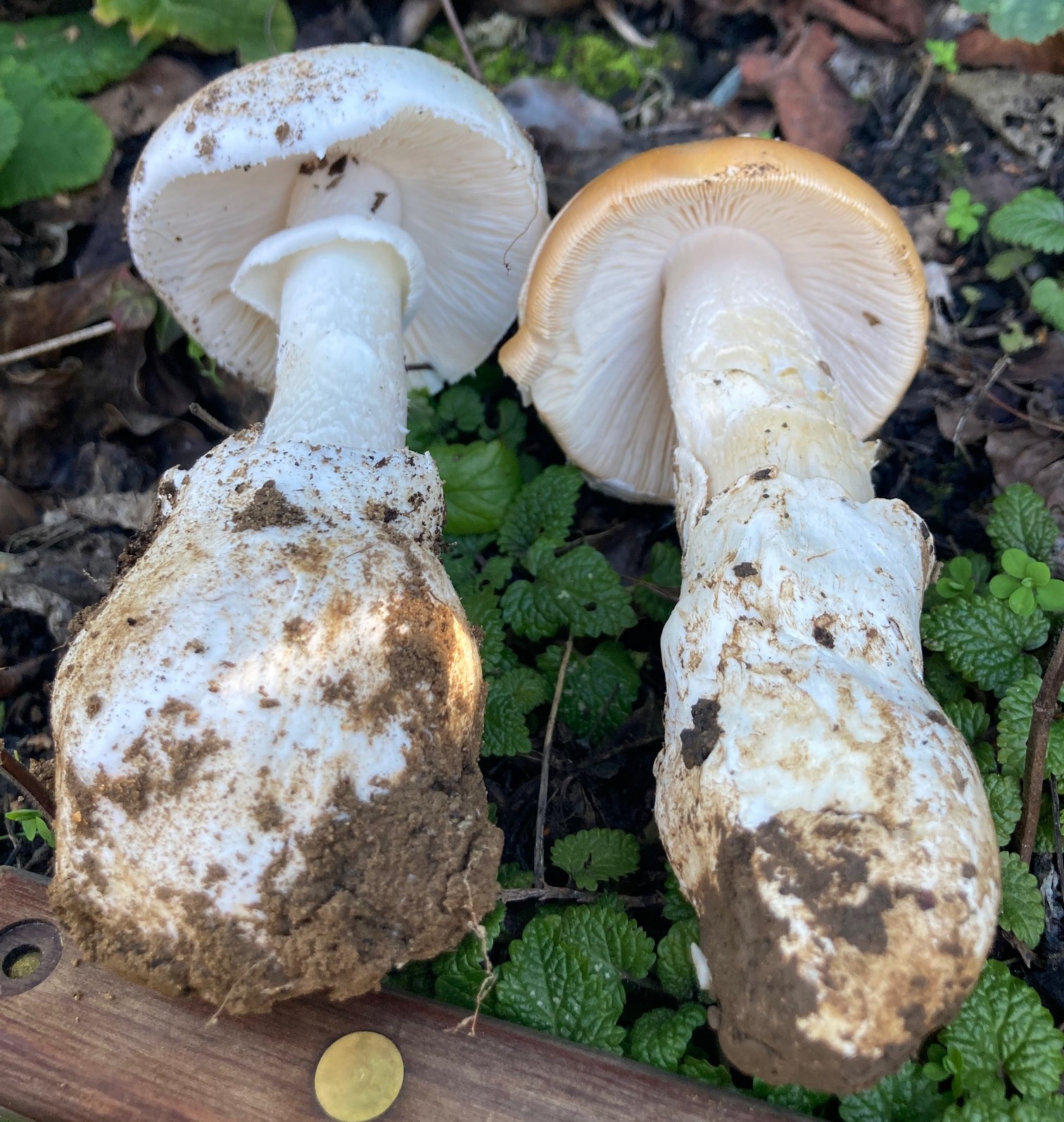 A. ocreata vs. A. velosa In central California, A. ocreata and A.velosa both associate with live oak. There is a general rule of thumb that one comes up closer to the base of the tree and the other toward the edge or even outside the canopy of the tree. This may be true, but they can also be found growing next to one another. People can get a little crazed when in a patch of mushrooms, so take care to inspect each mushroom carefully. The cap color of A. ocreata is variable. Some are nearly pure white, while others can have quite a lot of cap color. The color can be anywhere from white to gray to tan to an apricot-like orange similar to A. velosa, but blotchy at best, never uniform like A. velosa. Sometimes the color is confined to the center of the cap with a light, off white halo at the margin. The cap of A. velosa is generally a beautiful pinkish apricot color, although there is a white variety. 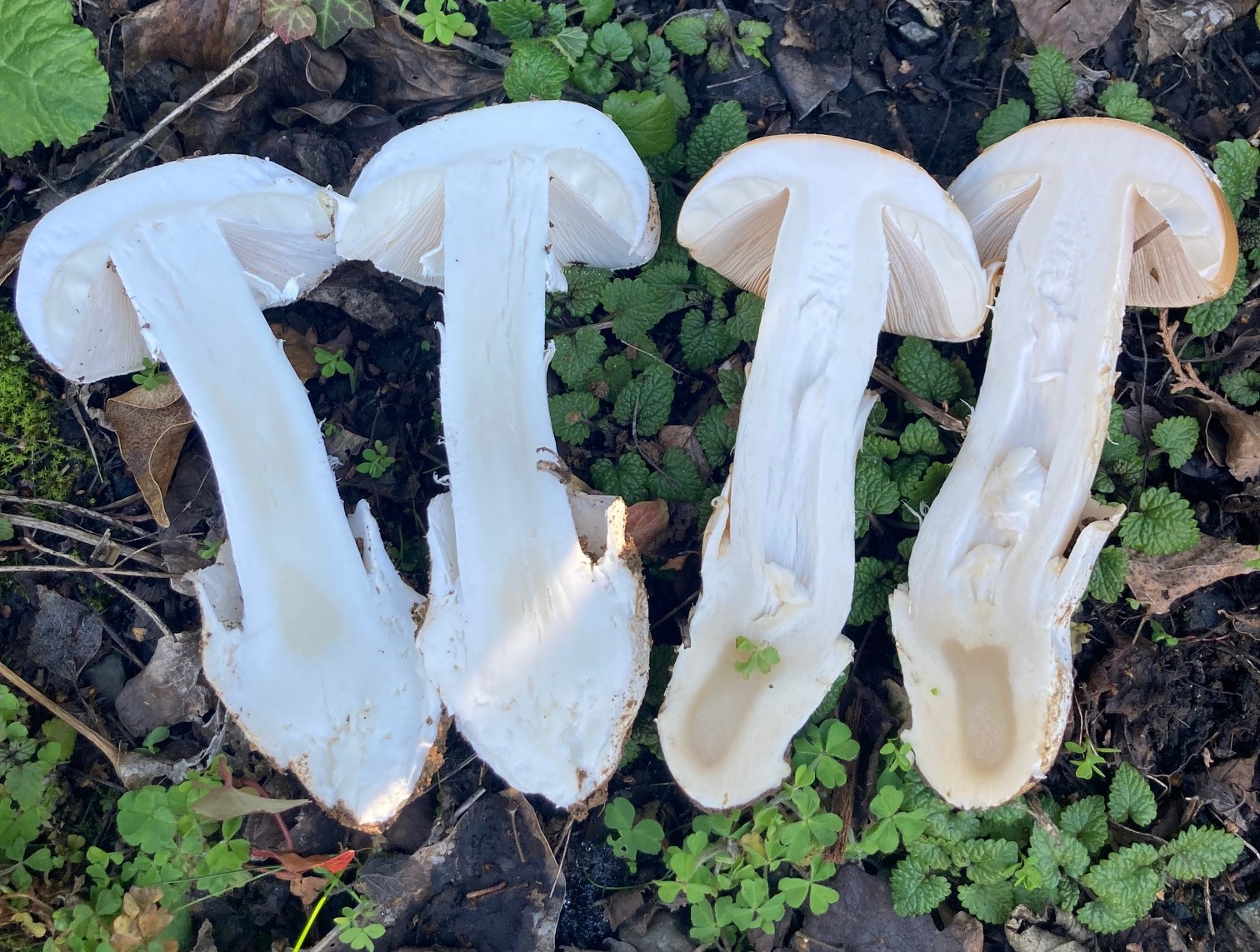 A. ocreata vs.A. velosa So, lots of variables. While getting to know A. velosa it’s best to eat only those with classic features, which include a thick, cottony skullcap of universal veil material, a beautiful uniform apricot-like cap color, with an obviously sulcate margin. Have a fruitful late winter/spring season! | |
| Mycena Newsletter - March 2025 |
